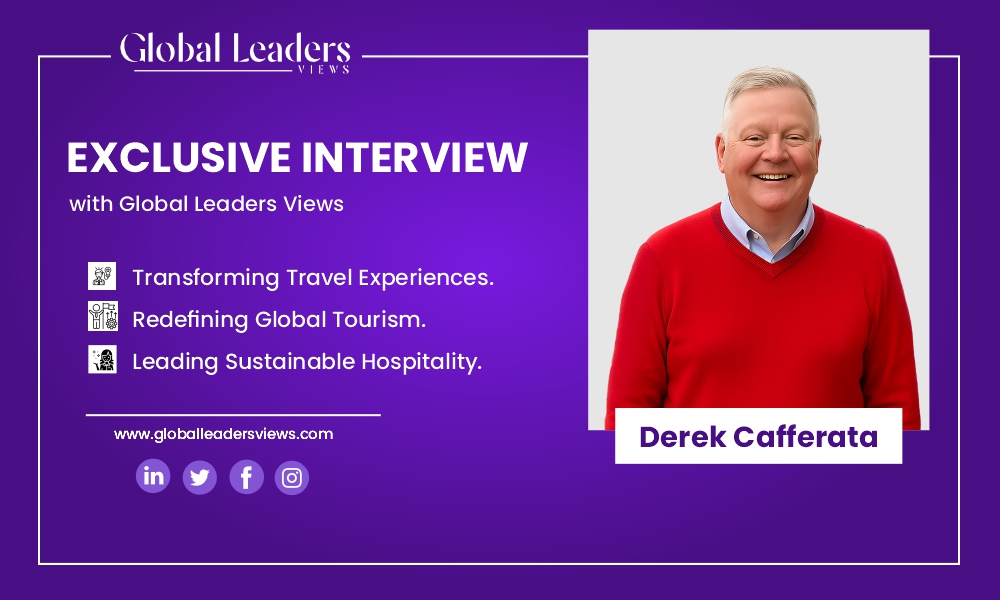
The global travel industry has always been built around movement. Airports, hotels, technology platforms, and tourism networks all exist to help people move across borders and experiences more efficiently. But for Derek Cafferata, travel has never been only about transportation or transactions. At its core, he believes travel is deeply human.
That perspective has become the foundation of Derek’s leadership philosophy and the reason he continues to stand out in a rapidly transforming industry. While many companies focus heavily on automation, scale, and digital acceleration, Derek remains focused on something equally important but often overlooked: the emotional experience behind travel itself.
Featured in the Global Leaders Views edition, Top Five Global Leaders Transforming the Travel and Tourism Industry in 2026, Derek represents a new generation of leaders who understand that operational excellence and human connection are not competing priorities. In fact, he believes the future of successful travel businesses depends on balancing both.
For Derek, travel is one of the few experiences capable of changing perspective in a meaningful way. He has long believed that stepping into new environments allows people to become more open-minded, empathetic, and connected to the world around them. That understanding shaped not only his view of travelers, but also his broader philosophy around leadership, innovation, and organizational culture.
Over the years, Derek developed a reputation for combining strategic discipline with emotional intelligence. He approaches business with clarity and precision, yet consistently emphasizes that systems and technology only matter when they improve the lives of people using them.
“Travel is ultimately about people,” Derek explains through his leadership philosophy. “Technology matters. Systems matter. But they only matter if they improve the human experience.”
That belief has guided his work across leadership roles and continues to influence the direction he sees the industry heading in the years ahead.
Learning the Business Beyond Operations
Derek’s understanding of the travel sector evolved through years of experience, observation, and collaboration with influential industry minds. One of the most important professional influences in his journey came through his collaboration with Roger Thomson.
Working alongside someone with deep expertise in global finance and strategic systems gave Derek a broader understanding of how sustainable businesses are built. More importantly, it reinforced the importance of long-term thinking, accountability, and disciplined execution.
While many organizations focus heavily on short-term wins or aggressive expansion strategies, Derek developed a more balanced perspective. He learned that growth alone is not enough if the systems supporting that growth are unstable or disconnected from customer trust.
That lesson became especially important as the travel industry entered periods of major disruption and transformation over recent years. From shifting traveler expectations to economic uncertainty and rapid technological change, the sector faced pressures unlike anything seen before.
During those moments, Derek observed a key truth about leadership: people do not follow strategy alone. They follow clarity, trust, and consistency.
He learned that teams respond less to polished presentations and more to leaders who remain steady during uncertainty. That realization continues to shape how he leads organizations today.
Rather than creating environments driven by pressure or fear, Derek focuses on building cultures centered around communication, alignment, and shared responsibility. People who work alongside him often describe his leadership style as calm, disciplined, and highly collaborative.
He believes leadership is not about controlling people. It is about removing unnecessary friction so talented teams can perform at their highest level.
Moving Beyond Growth for the Sake of Growth
In an industry often obsessed with disruption and expansion, Derek’s perspective feels notably grounded.
He does not believe businesses should pursue growth simply for visibility or headlines. Instead, he emphasizes sustainable economics, operational clarity, and long-term value creation.
That philosophy has become increasingly relevant in modern travel and hospitality markets, where companies frequently face pressure to scale quickly while simultaneously adapting to changing consumer behavior.
Derek believes many organizations make the mistake of prioritizing speed over structure. While rapid growth may create short-term momentum, businesses ultimately succeed when their systems, teams, and customer experiences remain stable under pressure.
For him, operational efficiency is not separate from customer satisfaction. The two are directly connected.
When internal systems operate smoothly, travelers feel the results through reduced stress, greater confidence, and more seamless experiences. The best travel experiences, Derek believes, are often the ones customers barely notice because everything simply works the way it should.
That philosophy is reflected strongly in the approach behind Travel Advances, where the focus remains on creating travel experiences that feel intuitive, trustworthy, and human-centered rather than overly transactional.
Derek believes the future of travel technology should simplify complexity instead of adding more confusion.
Too often, companies mistake innovation for adding endless features, interfaces, or automation layers. Derek sees innovation differently. He believes truly intelligent systems are the ones that reduce friction and make experiences feel natural.
The traveler should feel empowered, not overwhelmed.
Understanding the Modern Traveler
According to Derek, the travel industry is now entering one of the most important transitions in its history.
Traveler expectations have changed dramatically over the last decade. Today’s consumers expect far more than convenience or affordability. They want personalization, confidence, transparency, and seamless digital experiences that adapt to their preferences in real time.
Modern travelers are also navigating a world that feels increasingly unpredictable. Delays, changing regulations, economic uncertainty, and information overload have made trust more valuable than ever before.
Derek believes the companies that succeed in this new environment will not necessarily be the ones with the most technology. Instead, they will be the companies that use technology responsibly and intelligently.
His thinking around innovation was further shaped through insights gained from Rakesh Mittal, whose expertise in analytics and intelligent systems helped deepen Derek’s understanding of modern travel technology.
Those collaborations reinforced an important principle that now defines much of Derek’s leadership philosophy: innovation should reduce complexity, not create it.
That mindset stands out at a time when many businesses race to adopt artificial intelligence and automation without fully considering the human experience behind those systems.
Derek believes technology should support trust, clarity, and confidence rather than replace genuine customer understanding.
For him, the future of travel will depend heavily on how organizations balance intelligence with empathy.
Why Culture Remains a Competitive Advantage
While technology continues to dominate industry conversations, Derek believes organizational culture remains one of the most important differentiators any company can have.
He speaks openly about the importance of communication, accountability, and transparency inside leadership teams. In his view, culture is not created through mission statements or branding campaigns. It is reflected in daily behavior, decision-making, and how people treat each other during difficult moments.
Derek encourages open dialogue within organizations and believes strong teams are built when people can challenge ideas respectfully without creating division.
Humility, trust, and clarity are values he consistently prioritizes.
These principles became especially important during periods of disruption across global tourism and business markets. Derek observed that difficult moments reveal the true character of organizations very quickly.
Some businesses become reactive and disconnected under pressure. Others become stronger through communication and alignment.
Derek believes leaders must remain visible during uncertain periods. When challenges arise, communication should increase rather than disappear.
People need clarity more than comfort.
That leadership approach has helped shape environments where teams feel informed, trusted, and aligned with larger organizational goals.
Rather than relying on corporate slogans or motivational messaging, Derek focuses on practical leadership rooted in human understanding and consistent execution.
Adapting in a Rapidly Changing Industry
Despite years of experience across large-scale business environments, Derek continues to approach leadership with a mindset of continuous learning.
He believes adaptability cannot simply appear during moments of crisis. Organizations must build adaptability into everyday operations, decision-making, and culture.
That means staying close to customers, listening carefully to employees, and remaining aware of how quickly global expectations can shift.
For Derek, curiosity remains essential.
He believes some leaders become disconnected from reality once they move too far away from customer experiences or frontline operations. Maintaining awareness of how people actually feel about travel experiences is critical to building relevant and sustainable businesses.
This perspective also shapes the advice he gives aspiring entrepreneurs entering the travel and tourism space today.
He encourages founders to focus less on trends and more on people.
Too many businesses, he says, become obsessed with technology before truly understanding the emotional needs of travelers.
Travel is personal. It involves anticipation, uncertainty, emotion, and trust. Companies that fail to recognize that emotional dimension often struggle to create lasting customer loyalty.
Derek’s advice remains practical and grounded:
Build with clarity. Surround yourself with people who challenge your thinking. Focus on systems that solve real problems. And never lose sight of the human experience behind the business.
Defining the Future of Travel
As artificial intelligence, analytics, and automation continue reshaping the travel industry, Derek Cafferata remains focused on ensuring technology never overshadows the emotional value of travel itself.
He believes the future of the industry will not simply be defined by faster systems or smarter platforms. It will be defined by how effectively organizations create experiences that feel intuitive, trustworthy, and meaningful.
That balance between innovation and humanity is what continues to define Derek’s leadership approach.
In many ways, his philosophy reflects a broader shift happening across the global travel landscape. Travelers no longer want businesses that simply move them efficiently from one destination to another. They want experiences that reduce stress, create confidence, and feel personalized to their needs.
The companies capable of delivering those experiences consistently will become the leaders of the next generation of travel.
Derek believes achieving that future requires more than technology investment alone. It requires disciplined leadership, strong organizational culture, and a willingness to keep people at the center of every decision.
At a time when industries are becoming increasingly automated and transactional, Derek’s perspective serves as an important reminder that human connection still matters.
Because in the end, travel is not only about destinations.
It is about how people feel during the journey. And Derek Cafferata continues to build a future where those experiences feel smarter, simpler, and more human than ever before.